Versipel New Music Presents
High Voltage
featuring
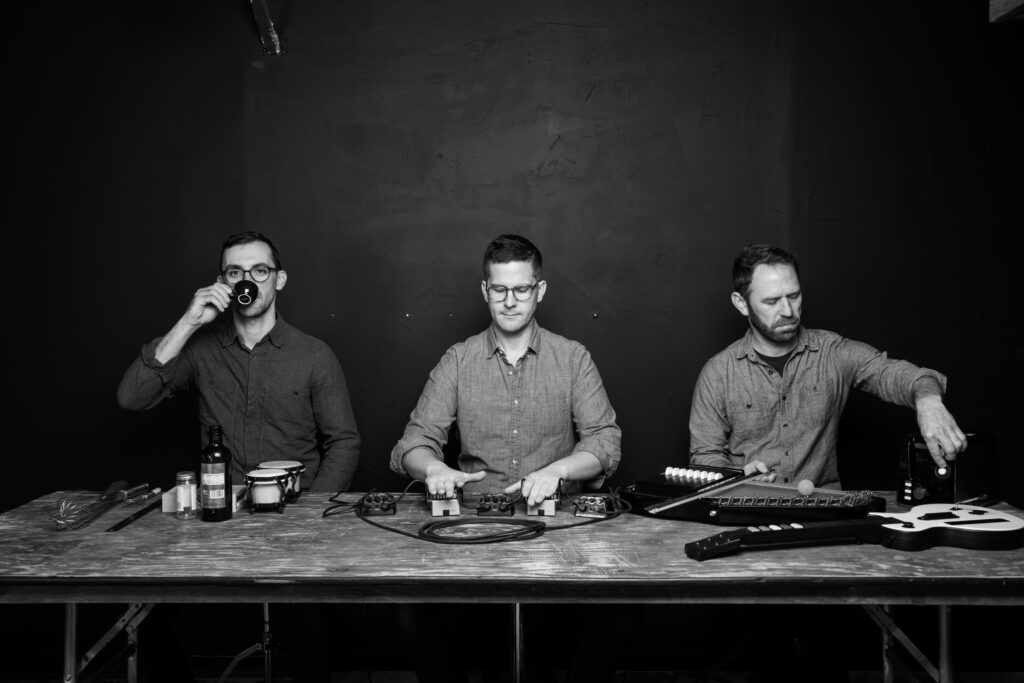
line upon line percussion
Saturday, February 21st – 7:00p
New Marigny Theatre
part of the nF Residency Series

DELULU looks at how desire is shaped by advertising systems, data tracking, and everyday consumption. Our interests are constantly monitored, and buying habits are analyzed by algorithms that learn when and how to present suggestions. Ads appear at moments when we are most likely to accept them. If you pause, click, or spend time looking at one, the system takes note and begins to push more of the same, narrowing what you see and reinforcing the loop. What starts as convenience can quickly feel intrusive, even unsettling.
In the piece, the drum player represents this commercial system – steady, confident, and endlessly optimized. Facing it is a human presence that reacts, adjusts, and makes choices that feel personal and self-directed, but are already framed by the system. DELULU questions how often our decisions are truly voluntary, and how easily convenience can become a form of control.
FIONA XUE JU originally from China, is a Ph.D. candidate in EMDM (Experimental Music and Digital Media) at Louisiana State University. She engages in interdisciplinary projects, working as a composer, media artist, improviser, performer, and sound and visual designer. Fiona holds a Bachelor’s degree in composition from Oberlin Conservatory and a Master’s in CoPeCo (Contemporary Performance and Composition) from CNSMD Lyon in France, with additional studies at EMTA in Tallinn, KMH in Stockholm, and HfMT in Hamburg. Her works, ranging from chamber music to multimedia productions, have been featured across the U.S. and Europe. Fiona’s practice merges electronic music with visual and performance arts, crafting immersive experiences that connect digital and physical spaces. Through her art, she invites audiences to challenge conventional perceptions of reality and society, while often incorporating political themes that cross cultural boundaries. More info & works for Fiona can be found at www.xjcomposer.com.
During a winter break trip to Yunnan, China, I came across a small shop selling souvenirs related to the traditional papermaking practices of the Dongba people. There I learned about the Dongba writing system, a unique form of pictographic script composed of graphic symbols. Closely tied to their spiritual beliefs, Dongba scriptures are written entirely in these pictographs, unfolding like a sequence of painted images. Impressions on Dongba is inspired by this unexpected encounter with the richness of Dongba culture.
In the piece, electronic sounds are primarily triggered using a digital drawing tablet (Wacom). As Dongba characters are drawn, the pen transmits data such as x–y position, pressure, and tilt angles, which are mapped to sound. The percussionists similarly “draw” the characters using superball mallets and drumsticks on frame drums and a suspended cymbal. Much of the electronic material is derived from transformed recordings of Dongba scripture recitation and singing from Mosuo Genesis, along with field recordings of local music, rituals, and dance.
JINXIN FU is a composer and a sound artist. His creative practice spans acoustic and electronic music, spectral processing, spatialization, and multimedia integration, highlighting his interdisciplinary approach to storytelling through sound. Drawing on this interdisciplinary background, his research interests include digital instrument design, sound diffusion techniques, and interactive multimedia practices. Through his music, Jinxin aims to bridge cultures, disciplines, and traditions, creating deeply personal and immersive sonic experiences. His work explores themes of cultural identity, connection, and shared humanity, drawing from his lived experiences navigating different traditions and artistic disciplines. At the heart of Fu’s creative practice is a commitment to fostering empathy, understanding, and connection. As a composer in an era of increasing division, he seeks to craft works that transcend cultural and disciplinary boundaries, amplifying diverse voices and celebrating our shared humanity. Jinxin is a first-year PhD student in EMDM at Louisiana State University. Originally from China, he holds a bachelor’s degree in electronic engineering and a master’s in film scoring from China, and a second master’s degree in music composition from Brigham Young University.
The idea behind this work is something that should be familiar to anyone who has been in New York City (or any cold-weather city) right after it snows. Initially, the city is quiet and peaceful, fresh snow adorning the sidewalks, trees, and rooftops. But after a day or so, the snow melts and refreezes as ice. And when you’re walking on the sidewalk, you can see that it is underneath the mix of snow, salt, and ice. But as you approach a street crossing, you’re never quite sure whether that mound of snow or sheet of ice is covering hard concrete, or is hiding a slushy, cold puddle of water waiting to invade your shoes and socks. Beware the deceptive slush puddle.
STEPHEN DAVID BECK (b. 1959) teaches music composition and electroacoustic music at Louisiana State University, where he is the Derryl & Helen Haymon Professor of Music. He received his PhD in music composition and theory from the University of California, Los Angeles, where he studied with Henri Lazarof, Elaine Barkin, Paul Reale, Alden Ashforth, and Roger Bourland. In 1985, he studied computer music at IRCAM with the support of an Annette Kade/Fulbright Fellowship and joined the faculty at LSU in 1988. Since 2003, he has held a joint faculty position at the Center for Computation & Technology, where he established the Cultural Computing group and led the development of the PhD program in Experimental Music & Digital Media.
INTERMISSION
a place where it rains has its roots in a desire to explore rhythmic cycles, microtonal modulation, and carefully chosen timbres with electronic extensions. Equally important for me was the idea of composing firsthand: music that I would perform myself, and that meant (in contrast to the standard concert work) not to really travel: a bespoke work for an arsenal of customized instruments. The procedures of various musical traditions—from West Africa to Java, the Caribbean to Southern India—provide a backdrop inspiration for busy percussion textures, but none is explicitly referenced; rather, they are reimagined in a context distanced from the associations that their resonance inevitably provokes.
What you will hear tonight is a work in process, the outer movements of a piece that will be twice this length. The first movement, Blades + Tines, concentrates on the sound of pitched metallic resonance. One percussionist plays an mbira (think of it as the alto member of the family), the second plays a kalimba (soprano) attached to a marimba (bass); all three instruments feature plucked metal tuned to a quarter-tone mode shared by the Fender Rhodes. Interjections from small percussion instruments and a metal balafon are heard, first acoustically then through a unique array of eight speakers—two monitors, two coffee cans, a calabash covered with bottlecaps, an overdriven guitar amp, and transducers affixed to two instruments: an autoharp and an Indian swarmandal/tanpura. The injection of varying degrees and types of “buzz”—bottlecaps, overdrive, jivari bridges, bitcrushing, cymbal rivets—introduces an element of noise that shades pure resonance.
The final movement, Strike + Strum, deals with contrasting materials: free reeds (on the melodica and harmonica) and steel strings that are hammered (santur) or gently strummed (autoharp). Again, all are retuned to a microtonal scale. Each movement builds toward a cymbal crash that triggers a moment of pure electronics, a sound file gains a layer with each appearance until a final swish triggers a minute of swirling, bit crushed cymbal resonance: an abdication of pitch and color in a final prolonged and processed wisp of noise.
a place where it rains was commissioned by line upon line Percussion and benefitted from the support of a YoungArts microgrant towards the cost of materials and modifications.
CHRISTOPHER TRAPANI earned a Bachelor’s degree from Harvard, then spent most of his twenties in London, Istanbul, and Paris, where he studied with Philippe Leroux and worked at IRCAM.
At thirty he moved to New York City, earning a doctorate at Columbia in 2017. He is currently Assistant Professor of Electronic Music and Digital Media at Louisiana State University.
Recent commissions have come from Klangforum Wien, Ensemble Modern, and Radio France. His works have been heard at Carnegie Hall, Southbank Centre, Wiener Konzerthaus, Ravenna Festival, and Wigmore Hall.
Christopher is a Guggenheim Fellow (2019), winner of the Rome Prize (2016) and the Gaudeamus Prize (2007). Waterlines, his debut portrait CD, was released on New Focus Recordings in 2018, followed by Horizontal Drift in 2022 and Noise Uprising in 2024.
Christopher splits his time between his hometown of New Orleans and his European base in Palermo, Sicily.
For more information on Dr. Trapani’s work visit www.christophertrapani.com.
line upon line
Matt Teodori – percussion, santur
Cullen Faulk – percussion, autoharp
with:
Stephen David Beck – computer
Christopher Trapani – microtonal Fender Rhodes and harmonica
Special Thanks
Versipel New Music Season 12 is generously supported by the following organizations:
- The Aaron Copland Fund for Music
- Arts New Orleans
- City of New Orleans
- National Endowment for the Arts
- New Orleans Theatre Association
- Southeastern Louisiana University Department of Music and Performing Arts
- Tulane University Department of Music
and the following donors:
- Jeffrey Albert
- Rebecca Banghart
- Stephen Beck
- Joseph Besharse
- Paul E Christopher
- Laura Cocks
- Licity Collins
- Cody Dehart
- Marti DuBuisson
- Brina Faciane
- Rose Gear
- Lauren Giunta
- Chloe Groth
- Kevin Harrell
- Megan Ihnen
- Eunmi Ko
- Mendel Lee
- Mel Mobley
- Edward M Moseley
- Victoria Novak
- Patricia Olson
- Mo Ran Park
- Greg Robin
- Gary Robinson
- Corey St. Romain
- Lewis Schuessler
- Philip Schuessler
- Richard Snow
- Johanna Ziegler
- Karaline Zeigler