
Our eleventh season opens with a program featuring selections from Eve Beglarian’s BRIM the River Project which was inspired by a human-powered trip down the Mississippi River that the composer undertook in 2009. The collection of pieces serves as a travel journal of places and people she met along the way and paints a picture of modern-day America. The program also features evocative, moving, and timbrally nuanced works by composers Carolyn Chen, Kaija Saariaho, and Marti Epstein.
Composer Bios:
Eve Beglarian
According to the Los Angeles Times, composer and performer Eve Beglarian is a “humane, idealistic rebel and a musical sensualist.” A 2023 winner of the Arts and Letters Award for “a spectacular body of work that innovates and takes enormous risks,” she is also a 2017 winner of the Alpert Award in the Arts for her “prolific, engaging and surprising body of work,” and has been awarded the 2015 Robert Rauschenberg Prize from the Foundation for Contemporary Arts for her “innovation, risk-taking, and experimentation.”
Her current projects include a solo piano piece about Emily Dickinson responding to Ives’ Concord Sonata for the pianist Donald Berman, a piece about water issues on the Colorado River for the Moab Music Festival, a queer exploration of 14th century composer Guillaume de Machaut’s multimedia love story, Le Voir Dit, with singer/performer Lukas Papenfusscline, and a piece for 24 basses in a grove of trees, composed for Robert Black and friends. Since 2001, she has been creating A Book of Days, “a grand and gradually manifesting work in progress…an eclectic and wide-open series of enticements.” (Los Angeles Times)
In 2009, “Ms. Beglarian kayaked and bicycled the length of the Mississippi River [and] has translated her findings into music of sophisticated rusticity. [Her] new Americana song cycle captures those swift currents as vividly as Mark Twain did. The works waft gracefully on her handsome folk croon and varied folk instrumentation as mysterious as their inspiration.” (New York Times)
Marti Epstein
Marti Epstein (November 25, 1959) started studying composition in 1977 with Professor Robert Beadell at the University of Nebraska. She has degrees from the University of Colorado and Boston University, and her principal teachers were Cecil Effinger, Charles Eakin, Joyce Mekeel, Bunita Marcus, and Bernard Rands.
Marti was a fellow in composition at the Tanglewood Music Center in 1986 and 1988 and worked with Oliver Knussen and Hans Werner Henze. As a result of her association with Henze, she was invited by the City of Munich to compose her puppet opera, Hero und Leander, for the 1992 Munich Biennale for New Music Theater. She was on the jury for the 1994 Biennale.
Marti has received commissions from the Paul Jacobs Memorial Commissioning Fund, the CORE Ensemble, ALEA III, Sequitur New Music Ensemble, the Fromm Foundation, guitarist David Tanenbaum, the American Dance Festival, the A*DEvant-garde Festival of Munich, tubist Samuel Pilafian, flutist Marianne Gedigian, the New England Brass Quintet, the Iowa Brass Quintet, Boston Conservatory, Boston University Marsh Chapel Choir, pianist Kathleen Supové, the CrossSound New Music Festival of Juneau Alaska, the Pro Arte Chamber Orchestra of Boston, the Radius Ensemble, the Ludovico Ensemble, and the Callithumpian consort. The Longy School of Music commissioned her to compose Quartet for BSO English horn soloist Robert Sheena to be played at the Inauguration of Karen Zorn, their new president. Marti’s music has been performed all over the world by ensembles, which include the San Francisco Symphony, the Radio Symphony Orchestra of Frankfurt, the Atlantic Brass Quintet, and Ensemble Modern.
The Atlantic Brass Quintet, Sequitur New Music, The Seattle Trumpet Consort, pianist Kathleen Supové, guitarist Ulf Golnast, Robert Sheena with the Boston Conservatory Wind Ensemble, and the University of Iowa Brass Quintet have recorded Marti’s music. In 2015, the Ludovico Ensemble recorded and released Hypnagogia, a CD of Marti’s music. Nebraska Impromptu, an album of her chamber music with clarinet, featuring Rane Moore and Winsor Music, was released in 2021 by new Focus Recordings. She was a resident at the MacDowell Colony in 1998, 1999 and 2022. She was a recipient of a 1998 Fromm Foundation Commission, and she won the 1998 Lee Ettleson Composition Prize. She is a recipient of a 2005 grant from the Massachusetts Cultural Council. Marti is a 2020 Guggenheim Fellow to compose works for Hinge Ensemble, loadbang, and soundicon. She is a recipient of a 2023 Chamber Music of America Commission to compose a new work for the Kozar/Byrne duo.
Marti is an active pianist and a devoted teacher. She plays prepared piano with guitarist David Tronzo in the Epstein/Tronzo Duo. She is Professor of Composition at Berklee College of Music, where she has taught harmony, counterpoint, and composition since 1991, and is also on the faculty of Boston Conservatory. Marti is a 2020 Guggenheim Fellow in Music Composition.
Kaija Saariaho
Kaija Saariaho (1952-2023) was a leading voice of her generation of composers, in her native Finland and worldwide. She studied composition in Helsinki, Freiburg and Paris, where she lived from 1982 to her death. Her studies and research at IRCAM, the Parisian center for electroacoustic experimentation, had a major influence on her music, and her characteristically luxuriant and mysterious textures were often created by combining live performance and electronics.
After her breakthrough piece Lichtbogen for ensemble and electronics in 1986, Saariaho gradually expanded her musical expression to a great variety of genres, and her chamber pieces and choral music have become staples of instrumental and vocal ensembles, respectively.
She rose to international preeminence as the composer of works taken up by symphony orchestras around the world, such as Oltra Mar (1999), Orion (2002), Laterna Magica (2008) and Circle Map (2012), as well as six concertos (including Graal Théâtre for violin in 1994 and Notes on Light for cello in 2006), and five major symphonic song cycles (e.g. Château de l’âme in 1995 and True Fire in 2014), all of which bear the mark of her relentless attempt to blend the scientific, technological and rational with an approach grounded in poetic inspiration and resulting in deeply sensorial and associative experiences.
Saariaho’s broadest public and critical recognition came from her work in the field of opera: L’Amour de loin (2000), Adriana Mater (2006), La Passion de Simone (2006), Émilie (2010), Only the Sound Remains (2016) and Innocence (2020), the latter of which was termed Saariaho’s ‘masterpiece’ by The New York Times, were all warmly received at their premieres, and have enjoyed the rare privilege of global tours and multiple stage productions. Their ever-expressive treatment of voice and orchestra, as much as their commitment to renewing the form and the array of stories being represented on the largest stages, have made these six very different opuses classics of 21st-century opera already in the composer’s lifetime.
Saariaho claimed major composing awards such as the Grawemeyer Award, the Nemmers Prize, the Sonning Prize and the Polar Music Prize and two of her recordings have received Grammy Awards. She was named ‘Greatest Living Composer’ in a survey of her peers conducted by the BBC Music Magazine in 2019.
Kaija Saariaho’s life was prematurely interrupted by a brain tumor in 2023. Her musical legacy is carried forward by a broad network of collaborators with whom she has worked closely over the years, and her publisher Chester Music Ltd.
Carolyn Chen
Carolyn Chen has made music for supermarket, demolition district, and the dark. Her work reconfigures the everyday to retune habits of our ears through sound, text, light, and movement. Her studies of the guqin, a Chinese zither traditionally played for private meditation in nature, have informed her thinking on listening in social spaces. Recent projects include an audio essay on a scream and commissions for Klangforum Wien and the LA Phil New Music Group.
Described by The New York Times as “the evening’s most consistently alluring … a quiet but lush meditation,” Chen’s work has been supported by the American Academy in Berlin, the Fulbright Program, ASCAP Foundation’s Fred Ho Award, Paul and Daisy Soros Fellowships for New Americans, Stanford University Sudler Prize, and commissions from Green Umbrella, MATA Festival, and impuls Festival. The work has been presented at festivals and exhibitions in 25 countries, at venues including Carnegie Hall, the Kitchen, Disney Hall (Los Angeles), Museum of Contemporary Art Chicago, the Guggenheim Bilbao, and the Institute for Provocation (Beijing). She has been fortunate to work with ensembles including SurPlus, Southland, San Francisco Contemporary Music Players, Aperture, andPlay, loadbang, koan, Dog Star Orchestra, The Reader’s Chorus, Pamplemousse, Chamber Cartel, orkest de ereprijs, S.E.M., red fish blue fish, Wild Rumpus, and The Syndicate for New Arts.
Writing and recordings are available in MusikTexte, Experimental Music Yearbook, The New Centennial Review, Leonardo Music Journal, Perishable, the wulf, and Quakebasket. Chen earned a Ph.D. in music from UC San Diego, and a M.A. in Modern Thought and Literature and B.A. in music from Stanford University, with an honors thesis on free improvisation and radical politics. She lives in Los Angeles.
Program Notes:
Cendres by Kaija Saariaho
Cendres (1998)
“I found the basis of the musical material for this piece in my double concerto … à la fumée for alto flute, cello and orchestra. The name of the piece also derives from this.
While writing Cendres, I was mainly concentrating on the interpretation of particular musical ideas by the three different instruments of the trio, each of which has its unique character and palette of colours. Musical tension is created and regulated by sometimes bringing the instruments as close together as possible in all ways (pitch, rhythm, dynamics, articulation, colour etc.), or, at the other extreme, letting each of them express the music in their most idiomatic fashion. Between these two extremes there is an unlimited number of possible ways to create more or less homogenous musical situations. The consciousness of this variety was the rope on which I was balancing whilst working on the piece.
Cendres was commissioned by the Gesellschaft fur Neue Musik Ruhr and Kulturbüro der Stadt Essen for the Wolpe Trio.”
Kaija Saariaho
Well Spent by Eve Beglarian
Well-Spent (2011) was written in response to a line in one of Leonardo’s notebooks that I came across soon after traveling down the Mississippi River by kayak and bicycle in 2009.
L’acqua che tochi de fiumi, è l’ultima di quella che andò, e la prima di quelle che viene; così il tempo presente. La vita bene spesa lunga è.
Leonardo: Notebook 1174
The water you touch in a river
is the last that has passed
and the first that is coming;
so with the present moment.
The well-spent life is long.
(evb translation)
The pre-recorded track of Well-Spent is made from Mary Rowell’s recording of the Muddy Waters 1942 tune You Got to Take Sick and Die Some of These Days. Well-Spent was commissioned by Ron Blessinger and the Third Angle Ensemble in memory of Donna Drummond. Many thanks to the Montalvo Arts Center, where I made the piece.
ache bind blind break by Carolyn Chen
In ache bind blind break, something throbs like a headache that won’t go away. In the background, other elements swim and surface out of the monotony of throbbing. They come from different listening worlds, but they converse nonetheless. Some things seem unforgiving. Others bend with time. Sometimes the listening bends before the sound.
Nocturne by Kaija Saariaho
Nocturne (1994) is a 6-minute miniature created by Kaija Saariaho as a tribute upon hearing of the passing of Witold Lutosławski. However, it does not refer to the Polish master’s output, but instead utilizes material from the violin concerto Graal théâtre, on which she was working at the time. The first performance of Nocturne was by John Storgårds on 16 February 1994 in Helsinki.
Far from being a minor work, Nocturne is one of the most compact and intimate demonstrations of Saariaho’s art of letting a singular voice emerge from the noise of the world in a lively ascending dance, until darkness engulfs it again.
Testy Pony by Eve Beglarian
Testy Pony is a setting of the poem of the same name by Zachary Schomburg. I read the poem shortly before the first concert of my River Project and felt it embodied something about my trip down the Mississippi River.
Here is the text of the poem:
I am given a pony for my birthday, but it is the wrong kind of pony. It is the kind of pony that won’t listen. It is testy. When I ask it to go left, it goes right. When I ask it to run, it sleeps on its side in the tall grass. So when I ask it to jump us over the river into the field I have never before been, I have every reason to believe it will fail, that we will be swept down the river to our deaths. It is a fate for which I am prepared. The blame of our death will rest with the testy pony, and with that, I will be remembered with reverence, and the pony will be remembered with great anger. But with me on its back, the testy pony rears and approaches the river with unfettered bravery. Its leap is glorious. It clears the river with ease, not even getting its pony hooves wet. And then there we are on the other side of the river, the sun going down, the pony circling, looking for something to eat in the dirt. Real trust is to do so in the face of clear doubt, and to trust is to love. This is my failure, and for that I cannot be forgiven.
Oil and Sugar by Marti Epstein
Inspired directly by visual art, oil & sugar for flute, clarinet, and piano takes its title from a video by the French conceptual artist Kader Attia’s 2007 video piece, which Epstein saw in Boston’s Institute for Contemporary Art. The video is of a large block of sugar cubes over which motor oil is poured, resulting in a paradoxically gorgeous, slow-motion destruction involving two global commodities. With its vibrating, constantly changing surface, oil & sugar, composed in 2016 forSarah Brady, Rane Moore, Gabriela Díaz, and Donald Berman. -Robert Kirzinger
Wet Psalm by Eve Beglarian
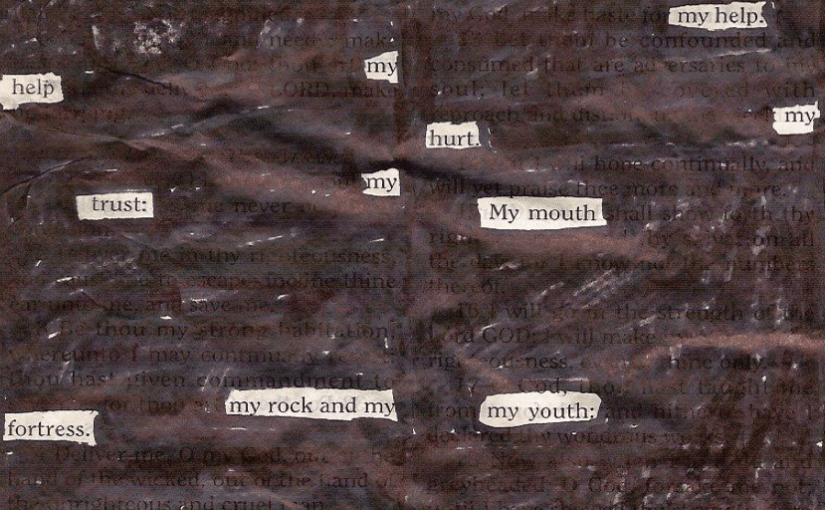
Wet Psalm is a setting of a poem by Linda Norton, which is based on a page from a rain-soaked bible she found in the Lower Ninth Ward in New Orleans, Louisiana in April 2008. The page has parts of Psalms 70 and 71, which become the text for the piece, inflected by Linda’s alterations.
The pre-recorded electronics are created from a recording Eleonor Sandresky made of me improvising on a broken Vietnamese dan tranh, an instrument given to me in 1997 by the performer Nguyen Thu Thuy.
The piece was commissioned by The ASCAP Foundation Charles Kingsford Fund. The world premiere by BRIM and the Guidonian Hand was on 1 June 2012 on the Tribeca New Music Festival at Roulette.

 Versipel New Music