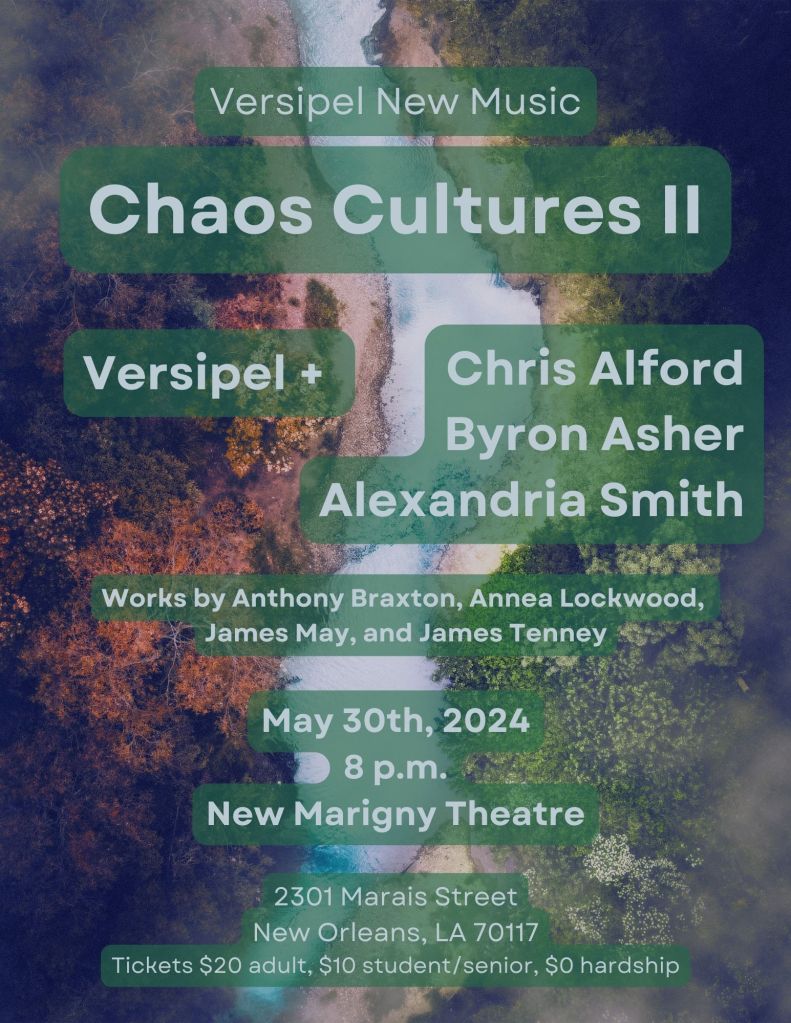
May 30th, 2024 at 8:00 pm
2301 Marais Street, New Orleans, LA 70117
Versipel New Music closes its tenth season with a special collaboration with a trio of incredible guests. The concert will feature the world premiere of James May‘s commissioned work dredge i for the Versipel Collective with Chris Alford, Byron Asher, and Alexandria Smith. Additionally, the program includes Anthony Braxton’s Composition No. 245, James Tenney’s In a Large Open Space, and Annea Lockwood’s bayou-borne.
Tickets: $20 adult, $10 student/senior, $0 hardship
Program Notes and Bios:
James May is a composer, improviser, teacher, and writer based in New Orleans. His work explores unfurling, fragile spaces through notated scores, improvisation environments, live electronics, field recordings, extended vocal technique, and text. He’s especially interested in combining techniques to encourage exploration of new sound or generate unpredictable systems in which performers can dwell. He’s a member of Versipel New Music, has published writing in Sound American and RTÉ Culture, and teaches courses on music production techniques and field recording at Tulane University
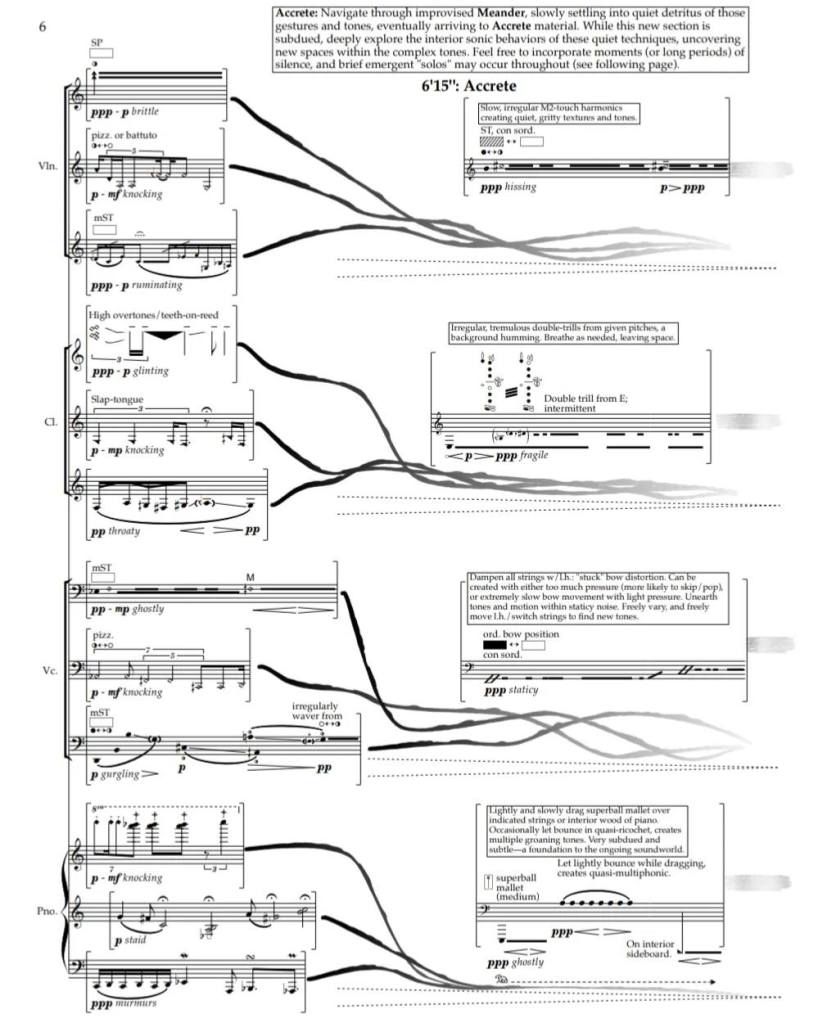
About dredge i, May states: Since 2019 I’ve lived two miles from the Mississippi River as it meanders around New Orleans. Nowhere in my life have I been more aware of the local climate, how the environment around me behaves and how it responds to humans. The Mississippi has always navigated its own way through the lower delta and into the Gulf of Mexico, leaving a meandering wake through the swamp. This structured meandering fascinates me, a singular entity pulling water from the entire country splitting and churning through its last inexorable motion. It’s a model that resonates with my sense of sonic material, a mass of content moving through itself and responding to its boundaries, dredging up a path in the process. In dredge i the performers navigate fragile material through such a journey, and are accompanied by additional free improvisers complicating the path. The score encourages new movement and uncovers novel sonic behavior, letting the performers dwell with their sounds and the complex environment in which they find themselves, each sound simultaneously independent and part of the swampy whole.
James Tenney (August 10, 1934 – August 24, 2006) was an American composer and music theorist. He made significant early musical contributions to plunderphonics, sound synthesis, algorithmic composition, process music, spectral music, microtonal music, and tuning systems including extended just intonation. His theoretical writings variously concern musical form, texture, timbre, consonance and dissonance, and harmonic perception.
His work “In a Large, Open Space” was composed in 1994 after he visited the Minoritenkirche in Krems, Austria. In the score, the words appearing directly after the title are “within which the audience is able to move freely, for any 12 or more sustaining instruments”. While they are spread out in the space, players of instruments which can play sustaining tones will choose, and softly play, pitches from a range selected by the composer. Because the audience is able to move about in the space, they can listen to the resulting sonic environment, which will fill the space like light does, from a variety of perspectives.
New Zealand-born American composer Annea Lockwood brings vibrant energy, ceaseless curiosity, and a profound sense of openness to her music. Lockwood’s lifelong fascination with the visceral effects of sound in our environments and through our bodies—the way sounds unfold and their myriad “life spans”—serves as the focal point for works ranging from concert music to performance art to multimedia installations.
Lockwood states: Bayou-borne, for Pauline (2016-17) is dedicated to Pauline Oliveros and was composed with her passions in mind. She was born in Houston so I created a graphic score from a map of the six bayous which flow through the city, thinking that she would have known them intimately as a child – swimming, wading, mud between her toes. She was a superb improviser, so it is scored for six improvising musicians with each player reading one of the rivers as a guide. Their lines move independently at first, the players moving closer together at the confluences to form duets and trios, before finally converging, the whole tone darkening as they approach Houston in memory of the devastation and deaths caused by Hurricane Harvey in 2017.
Anthony Braxton (born 1945), the Chicago-born composer and multi-instrumentalist, is recognized as one of the most important musicians, educators, and creative thinkers of the past 50 years. He is highly esteemed in the experimental music community for the revolutionary quality of his work and for the mentorship and inspiration he has provided to generations of younger musicians. Drawing upon a disparate mix of influences from John Coltrane to Karlheinz Stockhausen, Braxton has created a unique musical system that celebrates the concept of global creativity and our shared humanity. His work examines core principles of improvisation, structural navigation and ritual engagement – innovation, spirituality, and intellectual investigation.
From his early work as a pioneering solo performer in the late 1960s through to his eclectic experiments on Arista Records in the 1970s, his landmark quartet of the 1980s, and more recent endeavors, such as his cycle of Trillium operas and the day-long, installation-based Sonic Genome Project, his vast body of work is unparalleled. His small ensembles of the 1970s through to the present day are considered among the most innovative groups of their respective eras, while his Creative Orchestra Music has brought together the varying streams of American jazz orchestras, marching bands, and experimental practices with the traditions of European concert music in a wholly individual compositional voice. His continuing and evolving current systems of the past 15 years, including Ghost Trance Music, Diamond Curtain Wall Music, Falling River Music, Echo Echo Mirror House Music, and ZIM Music, have served as the artistic incubators for some of the most exciting artists of the current generation. Braxton’s many awards include a 1981 Guggenheim Fellowship, a 1994 MacArthur Fellowship, a 2013 Doris Duke Performing Artist Award, a 2014 NEA Jazz Master Award, and honorary doctorates from Université de Liège (Belgium), New England Conservatory (USA) and the 2020 United States Artists Fellowship.
Composition No. 245 (GTM). This work is part of Braxton’s Ghost Trance Music series, a set of roughly 150 pieces written between 1995 and 2006. Ghost Trance Music (or GTM) describes compositions specifically designed to function as pathways between Braxton’s various musical systems. One can think of GTM as a musical super-highway — a META-ROAD — designed to put the player in the driver’s seat, drawing his or her intentions into the navigation of the performance, determining the structure of the performance itself. At the heart of Braxton’s work is an emphasis on interpretation over execution, a feature designed to empower performers to trust their intuition. He achieves this balance through the provision of highly detailed parameters first defined in music written in the 1980s for his long-standing quartet featuring Marilyn Crispell, Mark Dresser, and Gerry Hemingway. In this context, Braxton conducted experiments using various collage techniques, particularly the synthesis of through-composed melodic lines and other written pieces, as well as areas of controlled improvisation. This afforded the ensemble opportunities to carve the structure of given performances while the musical material retained its integrity.
Click on the links below to learn more about our collaborating guest artists featured on the show tonight:
Byron Asher, saxophones/clarinets
 Versipel New Music
Leave a comment